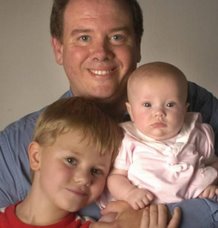
Fathers After 40 can now be found here.
Wednesday, November 14, 2007

Monday, November 05, 2007
Can we help this expectant father?
I got a post on a recent topic that I felt deserved a post of its own. Here it is:
On our 20th anniversary, my wife and I found out she was pregnant. I am 46 she is 45. We have a 16 year old daughter and a 13 year old son. We both are scared about being older parents and need help.
That must have been quite the anniversary surprise! My parents went through that as well - my mother and father were in their 40s when my brother and I came along, and had already raised three kids. I was still in college when my mother retired at 65. There were some advantages of being the late arrival, particularly in terms of stability. Most of my older siblings moved frequently in their youths as my dad went from job to job, while I spent my entire childhood in one neighborhood.
But I recognize as well that for the parents there are also significant downsides. I guess the key question is - what about being an older parent scares you?
Anyone else with thoughts?
Wednesday, October 31, 2007
No room for the changing table on the campaign bus
More from my semi-regular, semi-serious coverage of the '08 presidential campaign featuring an unprecedented number of older dads.
A group of five would-be first ladies recently joined host Maria Shriver for a Conference on Women in Long Beach, Calif.
I loved a quote from Jeri Thompson, wife of candidate and older dad Fred Thompson. During the conference, Jeri spoke indignantly about being asked to join the campaign bus, but being told there was no room for a changing table. (The couple have a son, Samuel, who is still in diapers.)
Jeri Thompson says she remembers responding "I'm not going unless they find room for the changing table."
Amen - you gotta have the changing table if you're making a long trip with baby. That didn't stop the quote from ending up as fodder on "The Daily Show." Jon Stewart ran a clip from the convention with Thompson's quote, then adds "...and that's how the world learned Fred Thompson wears a diaper." You can watch for yourself here, with that particular quote coming about two minutes into the clip. Standard language warning applies.
Photo: One of these things is not like the other...(L-R) Jeri Thompson, Michelle Obama, Ann Romney, Elizabeth Edwards, and Cindy Hensley McCain pose together after speaking at the California Governor and First Lady's Conference on Women on Oct. 23. Romney is the only one who did not have a child near the time or after their husband turned 40. AP Photo by Matt Sayles
Wednesday, October 24, 2007
New Autism web video tool
We've talked a lot about autism as a potential risk factor for older dads - in fact it could be argued that coverage of the autism study that showed the link led to the (long overdue) wave of coverage about the "male biological clock" phenomenon.
To many people, the spectrum of disorders associated with autism have been somewhat difficult to understand. What do they mean, for example, when they talk about such things as deficits in social reciprocity? Even if you can wrap your mind around the concept, you may not be sure if you're seeing those behaviors in your child.
If you're looking for help, there's a great new tool at the Autism Speaks Web site - an autism "video glossary" that helps explains some of the terms used in discussing autism. What I really like about the video glossary is that they have videos of "typical behaviors" in normally developing kids next to videos of similar behaviors that are acted out differently in kids who are showing red flags for autism. It really helps make some of the language much clearer to be able to see it.
You do have to register to use the site, but it's simple, just providing a name e-mail and password. I spent quite a bit of time on the site today and feel like I understand autism much better for having done so.
Thursday, October 18, 2007
Father figures, part 2: Nick Nolte vs. Scott Baio
The New York Daily News recently ran a story under the headline "'Grandpa dads' are the latest thing," about the supposed trend for late-life men having kids. They used Nick Nolte, 66, as one example. Nolte had a baby girl this month. Congrats to him.
But to talk about that as being part of a demographic trend, I'm here to tell you t'aint so. Actually, if you use Nolte as an example, there really is no trend for late-life dads having kids, in fact, despite high-profile cases such as Nolte and GOP presidential candidate Fred Thompson (see below) the phenomenon of men over 55 having children in some groups is actually decreasing. If you have to have a celebrity older dad, a better choice for poster boy may be Scott Baio, who at 45 is expecting his first child. (and is, in fact, used to being a poster boy.)
How do I know this? The CDC recently released its latest report on nationwide births, which covers the year 2004. As in previous years, the trend for men having children later in life is continuing. The following figures are based on live births per 1,000 men. The number of births in the 35-39 age group increased from 60.2 to 61.7. Also increasing, but less dramatically, was for the 40-44 age group, which rose from 23.4 to 23.9. Baio's age group, 45-49, also saw a slight increase.
Looking at the larger trend, going back 20 years, in 1984 there were 46 in the 35-39 age group and only 17.8 in the 40-44 group. (all of this is in table 21 of the report)
The CDC lumps everyone over 55 in one age group. That has remained steady for more than ten years, at 0.3 births per 1,000. Sorry, Nick Nolte, there won't be a lot of your same-aged peers pushing strollers down the red carpet. For white males, the number actually dipped for the first time in more than a decade, down to 0.2
Tuesday, October 16, 2007
Latest on the Male Biological Clock issue
As a reader pointed out in a post last week, Psychology Today has taken up the male biological clock issue in an article titled A Man's Shelf Life, written by Mark Teich. There's been much written about the risks of later fatherhood in the last year, but this is among the best I've seen and I'm grateful that it was brought to my attention.
Here's the paragraph that sets up the story, what we in the newspaper business refer to as the nutgraf:
Scientists have long known that advanced paternal age (like increased maternal age) played some role in fertility problems and birth defects. Yet because the reports mainly involved children who died before birth or who had extremely rare disorders, no one really rang the alarm. Now, with new studies linking the father's age to relatively frequent, serious conditions like autism, schizophrenia, and Down syndrome, the landscape is shifting.
Here's a good bit of advice I haven't seen in many of the other stories:
For men, the findings may be, above all, a clarion call to take better care of themselves. "This should make men reconsider their role and responsibility in childbearing," says Barbara Willet, of the Best Start childhood resource center in Ontario, Canada. "Aging in men is an important issue, but health is the key issue. It's as if we're suddenly aware that men who want to be fathers need to be healthy, too."
and the related conclusion:
Men can't rewind their biological clocks, but they can slow them down, Fisch agrees. Just remember, once you're in your 40s, you're past your maintenance-free years—you have to take care of yourself. "If you want children from then on," he advises, "get into the best shape of your life."
[Fisch refers to Harry Fisch, director of the Male Reproductive Center at Columbia Presbyterian Hospital in New York City and author of The Male Biological Clock.]
While we're on the topic, there's one thing I'd like to point out about my interview with ABCnews.com. I had a fairly lengthy interview with the reporter, and only a little bit of that was used. That's not a problem, as a reporter I do that to people all the time and I knew going into the interview that it was likely to happen. Plus, you could argue it really wasn't on-topic for a story that was about politics, not genetics.
Anyway, the point I made during our discussion was that the risks of being an older dad may be a recent media phenomenon but it is not a recent scientific phenomenon. The link has been known by geneticists for years. In fact, the advisory on advanced paternal age by the American College of Medical Genetics goes back at least to 1996. You can read that here. So even if it didn't make the story, I felt like it was worth mentioning here.
Wednesday, October 10, 2007
More than PTA: Group focuses on dads' skills to help school

Here's an idea I really like.
A group of dads have gotten together at Florence Elementary School in north High Point (just over the Guilford County line from here) to help provide positive male role models for the kids and to give dads a way to pitch in beyond the PTA.
Today I talked to Gregg Schlaudecker, one of the founders of the group. He said the plan is modeled after a similar program at Morehead Elementary, which is also in the Guilford County school system.
Schlaudecker said the organization allows men to help the school using the skills that come with being a father. Members have done things like "lunch buddies," which pairs dads with students who need a positive role model. The group has also helped with the landscaping around the school, doing some of the "heavy lifting" end of beautification, he said. Others have gone into the classroom for career presentations.
It's all about making sure that dads are a visible and positive force in the school, Schlaudecker said. There are about 750 kids there, but the number of male employees could be counted on one hand, he said.
"It feels good getting guys involved at the school," he said.
The group started last year and has about 45 members. Schlaudecker said he's hoping to double that number this weekend - the group is holding a Dads' Club Breakfast Saturday in the school's cafeteria at 8:30 am for interested dads. Principal James McNeil is the keynote speaker. For information, send an e-mail to dadsclub@florencepta.org
Wednesday, October 03, 2007
Newly released: "For the Love of Rachel"

Last week I had the pleasure of interviewing David Loewenstein, 47, a psychologist in Florida and author of the new book "For the Love of Rachel."
The book is about the birth of of Loewenstein's daughter, who was born prematurely weighing just 18 ounces, and how that frightful experience changed the life of Loewenstein and his family. Rachel spent the first nine months of her life in the NICU, and there were those who thought she would never make it. Once at home, there were others who doubted that Rachel would ever walk or talk. Now she is doing grade-level work in a traditional middle school.
Through it all, Loewenstein said that Rachel's birth and the adoption of Amy, her 6-year-old sister, has made him a better father than he otherwise might have been, as well as a better psychologist, and a better person overall.
Here's what the Miami Herald said of the book:
Loewenstein tells his moving story of finding love and creating a family -- as well as coming to terms with life's challenges. Loewenstein weaves medical heroics with straight-from-the-heart emotion, giving readers a rare glimpse into the private life of a doctor and his family's brush with the fragility of human life.
I have created some audio files of our interview, or you can listen to the whole interview, which is a little over 30 minutes long.
In this excerpt, Loewenstein talks about Rachel's birth at 23 weeks, and some of the medical problems that resulted from her prematurity. (Running time, 1 minute, 37 seconds)
Loewenstein talks about the emotional challenges of writing the book and some of the lessons he learned from the process. (2:22)
Loewenstein describes himself as a perfectionist who once wanted to have the perfect child. But he's learned that parenting is all about the love you have in your heart. (0:43)
Rachel has taught Loewenstein a different way of measuring success in his children. (2:25)
To hear the full interview, during which Loewenstein talks about his motivation for writing the book, shares stories about his daughters, and passes along what he's learned from his father, click here. (33:40)
To find out more about the book, go here.
PHOTO: David Loewenstein with newborn daughter Rachel and wife Susan. Photo provided by the author.
Tuesday, October 02, 2007
The road to the White House is paved with freshly changed diapers
I wrote last week about the high number of new dads among the front-runners in the '08 presidential race. ABCnews.com is running a story on their front-page on the subject today. I'm quoted near the end. I though the reporter, Susan Donaldson James, had a nice take on the issue. She and I chatted for about 10 minutes yesterday.
Here is a link to the story.
Wednesday, September 26, 2007
Next White House resident may be an older dad

I noted back in May that when Tony Blair handed over the title of British Prime Minister to Gordon Brown, it was a changing of the guard from one older dad to another.
Turns out that the older-dad trend for the rich and powerful isn't just a Brit phenomenon. Look at some of the front-runners among the '08 race for the presidency:
On the Republican side, 65-year-old Fred Thompson has an infant son, Samuel. Joining him are fellow front-runners John McCain (has post-40 children both biologically and through adoption) and Rudy Giuliani. (Apparently Giuliani hasn't done as well balancing politics and parenthood - it's been widely reported that his children, now grown, do not support his bid for the presidency.)
Among the Democratic hopefuls, John Edwards, 54, had two children after he turned 40 - daughter Emma Claire, 9, and son Jack, 7. Barak Obama (b. 1961) had his second daughter, Sasha, in 2001. I'm not sure if he had hit 40 yet or not, but close enough in my book.
Not everyone is enthusiastic about watching older candidates schlep around their young children on the campaign trail. Here's a take from a recent column by NYT columnist Gail Collins, written shortly after Thompson entered the race:
It's not unusual for wealthy men to decide they can dive into fatherhood and Social Security at the same time. This presidential field is awash with candidates of late-middle-age whose kids can still qualify for Breakfast with Santa. But none are quite so old or have children quite so young as Thompson's. And these days it's hard for an overage dad to get away with absentee fatherhood, especially when mom is intimately involved in the management of his campaign, as Jeri Thompson, seems to be... Maybe the combination of kids and campaigning has left him too ground down to glad hand. Too pooped to pander.
Yeesh, not exactly "Father Knows Best," is it?
Photo: Republican presidential hopeful Fred Thompson, center, is joined on stage by family members as he campaigns in his hometown of Lawrenceburg, Tenn., Saturday, Sept. 15, 2007. At left, Thompson's wife Jeri holds their son Samuel, and daughter Hayden Victoria, 3, is 3rd from left. (AP Photo/Mark Humphrey)
Tuesday, September 18, 2007
Whose broad stripes and bright stars, and screaming cartoons...
It's Constitution Week, and my son Sean, who just turned 7, is always proud to have been born during the week that we celebrate one of the greatest works ever printed.
As part of that celebration, check out his recent version of the Star-Spangled Banner. It's sung in a number of different keys, an apparent but unspoken reference perhaps to Francis Scott Key, who wrote our national anthem.

We're still working with him on the actual lyrics. Near as I can tell, this is the way he interpreted it:
Oh say can you seeBy the dawn’s early light
What so proudly we hailed
By the twilight’s last gleaming
Whose stripes and bright stars
Through the perilous fight
Those cartoons that we watched
Were so powerfully screaming
And the red rocket’s ??? glare
And our flag was still there
Oh say does that Star - Spangled Banner make sense
Of the land of the free
And the home of the braves?
Is there a parent out there who can't relate to the screaming cartoon reference?
And for a great resource on Constitution Day, visit the National Constitution Center, made possible through the Annenberg Foundation and the Pew Charitable Trusts.
Monday, September 17, 2007
Are boomer parents living as recklessly as their teens?
Interesting op-ed piece in today's New York Times adds some perspective on the risky behaviors of teens. It was written in response to recent articles in the media about research showing adolescent brains to be "immature," which sometimes leads to their risky or obnoxious behavior.
In the piece, Mike Males, a researcher and founder of Youthfacts.org, throws it back to boomer parents and their own control problems. Males writes about Americans 35 to 54, noting that more than 18,000 died in 2004 from drug overdoses (an increase of 550 percent since 1975), they (we) have a higher risk for fatal accidents and suicides than people in the 15 to 19 age group, and adding a host of other statistics showing boomers are frequent guests of prisons and emergency rooms.
Males notes: "What experts label 'adolescent risk taking' is really baby boomer risk taking. It's true that 30 years ago, the riskiest age group for violent death was 15 to 24. But those same boomers continue to suffer high rates of addiction and other ills throughout middle age, while later generations of teenagers are better behaved."
Comes with a great headline, too: This is your (father's) brain on drugs
If you want to see a version of the story that created the original hubub, check out ScienCentral News.
Wednesday, September 05, 2007
Study: It's good for women to pick older dads, to a point
Interesting study from Vienna finds that women who choose men a few years older than they are likely to have more babies than those who choose partners of the same age, according to research published last month in the British online journal Biology Letters.
Researchers Martin Feider and Susanne Huber looked at a sample of about 10,000 births to Swedish parents. They found that most babies were born to women whose partners were about four years older than they were. For men, the most babies were born to dads whose partner was six years younger. The authors conclude that a man's preference for a younger mate and a woman's preference for an older one yields "fitness benefits for both men and women and thus may be an evolutionarily acquired trait." Golly, not the most romantic viewpoint, is it?
I have not read the full study ($30 to download? yeesh...) but in media interviews, the researchers opine that males may be attracted to younger females because they will have a longer time to be fertile, while women may be attracted to older men because they are more likely to have the resources to provide for their families.
The numbers don't hold up when one of the couple is significantly older than the other. At ten years difference, the number of children produced is the same as same-age couples.
In the interest of full disclosure, I'm two years older than my wife, and we have two kids.
Monday, August 27, 2007
Three of the sweetest words in the English language

Yeah, "I love you" is good to hear, but "Back to school" may be the best triple-word phrase ever coined.
It's been a long - so hot - summer, and back to school is not only a harbinger of cool times to come, but also a return to structure and whatever passes for normalcy around here. It's funny how many of the things I hated about school as a kid I now celebrate as a parent, foremost of which is the plain ol' predictable repetitiveness of it all.
Sean is going in to first grade and had a good summer. There were many valuable experiences along the way, but two really stand out in my mind.
The first was the West Side Civic Theatre's production of the Broadway play Seussical the musical. Sean was one of many kids who got to play a role as residents of Whoville. The late-night practices through his whole schedule off, but of course he didn't mind. He loved the music and the stories, and really enjoyed being part of the cast and learning how a play comes together. He's still singing the songs from the show.
The second thing that really made the summer memorable for him were two camps he took part in at the (relatively new) Children's Museum of Winston-Salem. He went to a one-week Harry Potter-themed camp and a geography camp. Both centered around stories and crafts, and he was excited about each day of camp. It's not unusual to hear him make a Harry Potter reference from camp or tell us about a story from South America or somewhere else far-flung from his world in Lewisville.
I've tried to tell Sean that he has had a very "storyful" summer. Hopefully it will be one he'll long remember. The kid in you hates to see it end. But the parent...
Photo: Sean (in red shirt) and other Whos during a rehearsal for the West Side Civic Theatre's production of Seussical, in June.
Thursday, August 16, 2007
Inventive dads
My friend Jim Toole sent me this link to a great NY Times story today. It's about how the trend of dads taking a more active role in their children's lives have led to new inventions and entrepreneurial opportunities for men, ideas nurtured by their child-raising experiences. As a guy who is still carrying around the wife's pink quilted Vera Bradley diaper bag, I say "Hallelujah."
The lede of the story is about Tommy Habeeb, a well-know actor, producer and a host of - how should we say - low-brow reality shows, as well as the inventor of the Water Bottle Nipple Adaptor. Habeeb, who has three kids including a 3-year-old son, is 49, according to Wikipedia. (That's my best bet, neither the story nor the biography on his web site list an age.)
Looking for manly dad stuff? The story lists a site called DadGear.com, with an eye toward the more rugged, masculine products aimed at dads. Good-bye, Vera Bradley.
On a way unrelated note, People Magazine reports that former Olympic figure skater Scott Hamilton, 48, and wife Tracie, 37, are expecting their second child in October.
Monday, August 13, 2007
New program for older students with developmental disabilities

I've written often here about the fact that the joys of older parenting come with the risk of potential genetic conditions. Those risks include Down syndrome and autism. I wrote a story in today's paper about a new program where a group of eight students with developmental disabilities will be sharing an apartment with eight students from UNC-Greensboro. The idea is to help the developmentally delayed students learn to live independently, with the help from a group of their typically developing peers.
I will be following the students along during the course of the year, so I'll post updates here as they appear.
Journal Photo by: Jennifer Rotenizer: Rasheika McLean, 21, participates in a dating etiquette class on Wednesday at the Zeke House in Greensboro. The program pairs people who have developmental disabilities with students at UNC-Greensboro.
Tuesday, August 07, 2007
Can we help this daughter of an older dad?
Today I got an anonymous response to a post I made in May, and since that post is kind of buried, I thought I would go ahead and make a new post out of it - here goes:
Is there a support group for children of older fathers? I'm the eldest child of a start-over-dad and have to make some tough decisions that none of my friends have made, and won't make until they are twice my age, and settled. I need some advice, on how I can take care of my aging father, without stopping my life. (I'm 27, single, and have recently started my career, and very fast feel as though I'm going to have four dependants.) I am also afraid that I don't have much time left with my father. Does anyone know where I can get some support?
You've raised an important topic here - caring for older parents when they get really older. I'm facing that now. My mother is 86, and has enjoyed remarkably good health until very recently, as her gait has become unsteady and she has shown some of the other signs of aging that she has been able to keep at bay until now. Of her five children I - the youngest - live the closest to her, so I'm often running her to the doctor, or taking her to her swimming class, or otherwise just helping her navigate the world. I don't consider it a burden, it's in a way an honor to repay for all the work she did in raising me. But it does take some balancing with two kids at home.
That said, I don't know of any sources specifically for people like us, whose parents are getting older just as we face our own milestones. I don't know where you live, but if it's local to us here in Forsyth County, NC, I can tell you from experience that Senior Services is amazingly helpful.
I hope you find the help you're looking for, and if you find any support groups please let us now and I will certainly post again.
Anyone else know of any groups or have any suggestions?
Monday, July 30, 2007
Life with a free-range baby
Delaney is walking! It started out as kind of a cross between a walk and a belly dance - like something you'd see in a David Lee Roth video - as she learned to master the unforgiving forces of gravity. Now she is able to toddle pretty much anywhere she wants, inviting a whole new element of danger into the mix. Our house has gone from plain ol' babyproofed to full-scale Fortress Garber.
But we welcome her move to the ambulatory world. We get to watch her transition from baby to toddler, and those changes are coming quickly now. She's very curious about words, loves to feed herself when given the opportunity, and - for the first time - is regularly sleeping through the night.
I can remember when Sean was making that same move, things just seemed to get easier, and it was a whole lot easier putting ourselves into a toddler's world, to try to understand it as they see it and teach them from that perspective.
Photo: "No, wait, don't help me, I can do it myself..."
Friday, July 27, 2007
Skip Prosser

As anyone who knows me knows, my ties to Wake Forest are deep and strong. So it was a sad day yesterday as rumors of Skip Prosser's passing were confirmed. He was a credit to the University, and not just because of what he did for the basketball team.
After I graduated from Wake in '86, I left my native Winston-Salem and travelled around quite a bit, but always within ACC Country. During those times, the basketball team was a constant source of pride for me. Win or lose, as long as I had the team to cheer for and follow, I had an ongoing connection to my alma mater. Today, there's nothing quite like watching my son don the black-and-gold tie-dye shirt to catch a game, or to watch little Delaney shake the plastic streamers that make up her Wake Forest pom-pom.
I started getting e-mails from my fellow Deacon fans soon after the rumors started flying yesterday, trying to ascertain what I knew, which at that point wasn't much. With confirmation came sadness. I've seen coaches come and go, and their departure always brings up the question about the future of the team. When a coach dies, though, it's different. It's more personal, even if, as with me, you don't know them beyond the games. You give pause, you mourn, you realize the team will be fine and there's a time to deal with that later.
I lost my father when he was about Skip's age, also to a heart attack. I thought about that a lot last night. How could I not?
We have lots of coverage on http://www.journalnow.com/
Photo by Journal photojournalist Bruce Chapman.
Monday, July 16, 2007
A must-read for those considering IVF/egg donation
Peggy Orenstein has written a lengthy and very compelling story in The New York Times Magazine that ran Sunday about the growth of in-vitro fertilization using donated eggs. For the most part the growth has come from the gray end of the parental-age spectrum, and in fact the practice has helped extended that range. The story opens with an anecdote from a woman who, was in her mid-40s when she underwent the procedure in 1992. (Her 6th-grade daughter had asked her what year Mom and Dad had met their donor - now there's a lede that will grab you! Apparently the child has known since pre-school about the donor.)
Many stories about IVF/donation focus on the decision, not as much on what happens after baby arrives. This story looks into a lot of the issues of having a child from a donated egg, including whether or not to tell the child how they were conceived.
On the subject of older parents, here is a quote I found fascinating:
"The birthrate among women ages 40-44 has risen 62 percent since 1990, while the rate among those in their late 40s has more than doubled. Among those who used I.V.F. in 2004, about a third of the 43-year-olds used someone else’s eggs; by 47 years old, 91 percent did."
Orenstein is the author of the memoir “Waiting for Daisy: A Tale of Two Continents, Three Religions, Five Infertility Doctors, an Oscar, an Atomic Bomb, a Romantic Night and One Woman’s Quest to Become a Mother.” In the article, she says she underwent an unsuccessful donor-egg IVF treatment before conceiving her daughter without the treatment.
Subscribe to:
Comments (Atom)