Monday, July 30, 2007

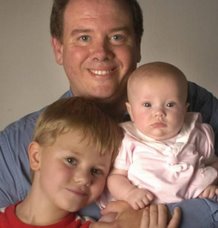
Life with a free-range baby

Delaney is walking! It started out as kind of a cross between a walk and a belly dance - like something you'd see in a David Lee Roth video - as she learned to master the unforgiving forces of gravity. Now she is able to toddle pretty much anywhere she wants, inviting a whole new element of danger into the mix. Our house has gone from plain ol' babyproofed to full-scale Fortress Garber.


But we welcome her move to the ambulatory world. We get to watch her transition from baby to toddler, and those changes are coming quickly now. She's very curious about words, loves to feed herself when given the opportunity, and - for the first time - is regularly sleeping through the night.
I can remember when Sean was making that same move, things just seemed to get easier, and it was a whole lot easier putting ourselves into a toddler's world, to try to understand it as they see it and teach them from that perspective.
Photo: "No, wait, don't help me, I can do it myself..."

Friday, July 27, 2007

Skip Prosser


As anyone who knows me knows, my ties to Wake Forest are deep and strong. So it was a sad day yesterday as rumors of Skip Prosser's passing were confirmed. He was a credit to the University, and not just because of what he did for the basketball team.

After I graduated from Wake in '86, I left my native Winston-Salem and travelled around quite a bit, but always within ACC Country. During those times, the basketball team was a constant source of pride for me. Win or lose, as long as I had the team to cheer for and follow, I had an ongoing connection to my alma mater. Today, there's nothing quite like watching my son don the black-and-gold tie-dye shirt to catch a game, or to watch little Delaney shake the plastic streamers that make up her Wake Forest pom-pom.

I started getting e-mails from my fellow Deacon fans soon after the rumors started flying yesterday, trying to ascertain what I knew, which at that point wasn't much. With confirmation came sadness. I've seen coaches come and go, and their departure always brings up the question about the future of the team. When a coach dies, though, it's different. It's more personal, even if, as with me, you don't know them beyond the games. You give pause, you mourn, you realize the team will be fine and there's a time to deal with that later.

I lost my father when he was about Skip's age, also to a heart attack. I thought about that a lot last night. How could I not?

We have lots of coverage on http://www.journalnow.com/

Photo by Journal photojournalist Bruce Chapman.

Monday, July 16, 2007

A must-read for those considering IVF/egg donation

Peggy Orenstein has written a lengthy and very compelling story in The New York Times Magazine that ran Sunday about the growth of in-vitro fertilization using donated eggs. For the most part the growth has come from the gray end of the parental-age spectrum, and in fact the practice has helped extended that range. The story opens with an anecdote from a woman who, was in her mid-40s when she underwent the procedure in 1992. (Her 6th-grade daughter had asked her what year Mom and Dad had met their donor - now there's a lede that will grab you! Apparently the child has known since pre-school about the donor.)

Many stories about IVF/donation focus on the decision, not as much on what happens after baby arrives. This story looks into a lot of the issues of having a child from a donated egg, including whether or not to tell the child how they were conceived.

On the subject of older parents, here is a quote I found fascinating:

"The birthrate among women ages 40-44 has risen 62 percent since 1990, while the rate among those in their late 40s has more than doubled. Among those who used I.V.F. in 2004, about a third of the 43-year-olds used someone else’s eggs; by 47 years old, 91 percent did."

Orenstein is the author of the memoir “Waiting for Daisy: A Tale of Two Continents, Three Religions, Five Infertility Doctors, an Oscar, an Atomic Bomb, a Romantic Night and One Woman’s Quest to Become a Mother.” In the article, she says she underwent an unsuccessful donor-egg IVF treatment before conceiving her daughter without the treatment.

Wednesday, July 11, 2007

Anyone have thoughts for this post?

Yesterday I got a response to a post that is a few weeks old, so I figured I'd make a new posting so people could see it and respond if they wanted to do so. Here is what was written:


Chapina said...
This is the first time I "blog," so you'll have to pardon me if it is posted under the wrong section. I am trying to find help with an unexpected pregnancy. I am 35 years old and my husband is 55. He was blessed with two children in his prior marriage and they are now adults. We thought that this would not be part of our future. Frankly, I have been filled with the sense of panic coming from him. I know he wants me to have an abortion, but I just cannot reason this option when we love each other, we are in a financially stable situation, we are very healthy. Any thoughts?


Chapina, I not going to weigh in on whether or not you should keep your baby - that is a decision between you and your husband, and perhaps a marriage or family counselor or a member of your clergy can help you. Given that both of you are of advanced parental age, you may want to consider genetic counseling as well.

Your situation brings up a lot of issues that we routinely talk about here. It's not possible to glean from your post why your pregnancy fills your husband with such panic, but that is something that will be important for you to know. It could be that he feels he's close enough to retirement that he's looking forward to a life without the day-to-day issues of raising a young child. Or perhaps, looking at costs such as college, etc, that perhaps he doesn't feel as financially secure as you do. He may also be worried about getting older and not being able to be there for his child.

Another possibility - it's not that he doesn't want to have the child, but he's worried about potential risks that come from advanced paternal age, and he fears for the health of the baby.

I hope it works out well for y'all. Anyone else have suggestions?


Tuesday, July 03, 2007

Poll: Marry later, keep your day job

A wealth of information is coming from a newly released PEW Research Center poll on the values and behaviors related to marriage and parenthood. Much of the press about this report has been focused on the finding that only 41 percent of respondents said that children were very important to a successful marriage - a surprising drop of more than 20 percent compared to 1990. (In fact, sharing of household chores was said to be very important by more of respondents - at 62 percent, a 15 percent increase since 1990.)

In scrolling through the findings, I found lots of interesting tidbits related to dads and older couples. Here are some that stand out:

* 51 percent said "it is a good thing for society that more people are
marrying for the first time at older ages." Only 4 percent said it was a bad thing.

* I've seen lots of blogs from stay-at-home dads (SAHDs), usually touting the benefits thereof. I would have thought that there was a growing acceptance of the practice. That's not what the researchers found. They found that 20 percent of women thought stay-at-home dads were a bad thing for society, the same number who said that 10 years ago. In fact, more men (23 percent) said it was a bad thing than women, a figure I found fascinating. (Almost 40 percent of women said more fathers staying at home so their wives could work full-time was a good thing, compared to only 32 percent of men who said that.)

* On the importance of both mom and dad, 69 percent tended to agree with the following statement: "If someone says a child needs a home with both a father and a mother to grow up happily, would you tend to agree or disagree?" But there was a pretty big difference among men and women on the question: 78 percent of men tended to agree, and 61 percent of women tended to agree. Looked at another way, more than a third of women tended to disagree that a child needs a home with both a father and a mother to grow up happily.

* What's the best age to get married? The answer differed when talking about brides vs. grooms. Only 14 percent said 30-or-over was the ideal age for a woman to marry, while 27 percent said a man should be 30 or older. In fact, more women (30 percent) said a man should be 30 or older than men (24 percent).

* Opposition by women to gay couples raising children has declined in the last decade, dropping from a majority of women opposed (56 percent) in 1997 to 42 percent in the current poll. (I don't have any stats to back this up, but I'm willing to bet that gay couples who adopt or otherwise have children tend to be older than their male-female counterparts.) More men in the recent poll said they opposed gays raisng children (59 percent), but the researchers did not provide previous results for men as the did for women.

Tuesday, June 19, 2007

Kick back and do a little reading

Another Father's Day come and gone - and with it goes the one time of the year where you can count on an abundance of coverage about fatherhood issues. There were lots of good stories in our pages and elsewhere. I wanted to point out some interesting reads for older parents, the best of what I could find from the Father's Day coverage. I should point out that I thought the overall coverage was good, with a little bit less of the cliched caricature of dads as the bumbling, emotionless, clueless shadow in the lives of their children.

Here are some stories that I recommend related to older parenting:

The Washington Post ran a feature by Philip Lerman, 51, whose son, Max, 5, is "on the spectrum" for autism, and how he is dealing with that. It's beautiful. Read it. Quoting:

"As I confronted the possibility that Max was On The Spectrum, the strangest thought occurred to me: If he is, then so be it.
I adored this boy whose main utterance sounded something like 'Joe Biden Go Baaden-Baaden,' this child who called everything "baw." Whatever he was, I would love him no less."

Lerman is the author of the recently released book "Dadditude: How a Real Man Became a Real Dad."

The Houston Chronicle's Claudia Feldman wrote about "A new age in fatherhood," with a subhead that reads: "Ready to teach and to learn, men in their 50s are reaping the rewards of having children and say it's worth the risks." Includes a bit of discussion about the "mortality issue," i.e. of knowing you'll be getting elderly just as your kids hit their prime.

And finally, Slate, the online magazine, wrote a story about fatherhood's effects on a man's body and brain under the headline :"Stretch Marks for Dads." Read the story and you'll find out that "evidence is accumulating that pregnancy and parenthood leave their marks on men's bodies. Women are not the only ones who are built for parenting, and recognizing that is good for fathers and the rest of us, too."


Let me know if you've seen a good story that we should add to this list.

Thursday, June 14, 2007

Happy Father's Day, y'all

I hope y'all will check out this really nice slide-show we're running, consisting of 36 testimonials from readers about thier dads. Very good stuff here.

My first post when I started this blog was of a Father's Day column I worte a few years ago, which I am reposting for the occasion.

Enjoy the new ties, the cookouts, the ball games, or whatever makes the day special for you. I'm getting new tackle, and taking my son on his first fishing outing.


THE FATHER IN MY HEART
PAT GARBER

A few weeks ago, I found a picture of my Dad that I had never seen.
It has quickly earned a special place in my heart.
I don't value it for the quality of the photograph. It's far too overexposed for that. There's so much light coming into the camera lens that most of the details have been completely washed out. My father's face is almost completely lost in a bright flash of white that almost overtakes the whole frame.
But there's enough detail to show that he has his arms wrapped around me and my brother Scott as we stare, blank-faced, into the camera, as we pose by a tree.
The picture was taken near the home where we lived, on the corner of West End Boulevard and Jarvis Street, in August 1964. I was 14 months old, my brother was 2, and my father was 46.
Eight years after that grainy black-and-white photo was taken, my father died.
I have few photographs of my Dad. I like this one the best because it's the only one that I know of that shows the loving bond between him and me.
I know that bond was there, nurtured over countless trips to Tanglewood and the Nature Science Center that was once in Reynolda Village. My Dad, my brother and I did many things together, and I considered him my best friend.
If we had known he would be gone when I was just 9, I'm sure more pictures would have been taken. As it was, Dad was our family's photographer. He's in precious few of the family photographs that fill several freezer bags at my mother's house.
He was usually behind the lens, preferring to snap the picture instead of appearing in it. I still have the camera, part of the Kodak Retina Series of cameras, that he used in the last years of his life.
I'll be darned if I know how to use it. But I often wonder, as I look through its viewfinder, if we compose the world in the same way - as if I could look into this vastly changed world and somehow figure out some kind of universal truth that the two of us could see together that could be captured forever on film.
I'll never really know.
It's part of the mystery of losing a parent at such a young age.
Just as you could look at the picture and wonder about the ghostlike features that the sun erased 40 years ago, I can trace my life through time and wonder how things would have been different had my father been there for me beyond the nine years we spent together.
But I'll never really know.
I am a father, too. My son, Sean, is 3. Already, the pictures I have of the two of us could fill a freezer bag.

Tuesday, June 12, 2007

Don't be afraid to cuddle them newborns! Study finds babies soothed just as much by dads

It was a fluke of our daughter's birth that I got to hold our little newborn earlier and longer than my wife did - blame it on the pre-eclampsia and the prematurity. Those first encounters with the baby were somewhat intimidating, with her hooked up to all those tubes and wires. But despite the difficulties she had to go through to get into this world, I thought she was a remarkably calm baby to hold and was easily comforted. Desiree didn't get to hold the baby until the next day, so I was hoping that somehow a parental bond was being formed until she could recover enough to get to the NICU.

Turns out, I may have been helping more than I thought. A new study out of Sweden sheds some light of the importance of the father's touch when the mother is not around. (Full disclosure - the study focused on skin-to-skin contact. In my case, I was wearing a shirt. It's not like I was gonna go traipsing around the NICU like Tarzan when I held my baby.)

Anyway, back to the study. The authors studied 29 babies born by C-sections. The babies spent a brief amount of time with their mothers, then the next two hours with their dads. 14 of the fathers were asked to care for their babies on their chest, skin-to-skin. The others comforted their babies as they lay on a cot next to them.

The researchers found that the babies who were held by their dads cried less, settled down for naps earlier and were better prepared to breastfeed when their mothers returned than the babies placed in the cots were.

You can read more about the study on WebMD and Science Daily.

Monday, June 11, 2007

BabyQuest on MSNBC

There's a decent discussion about when is the best time to have a baby on msnbc.com as part of a special online series they're calling BabyQuest: The modern pursuit of parenthood. (A new story every week until July 5, on subjects such as "Will science render men unnecessary?" )

Here's a few excerpts from the exchange:

My wife and I met later in life and by the time we were ready to have children we ran into difficulties. After three failed IUIs and two failed IVFs we decided to adopt. We adopted our son from Russia two years ago and couldn't be happier.
— Jeff, Frisco, Texas

I had my first child three weeks shy of my 22nd birthday, and my son 16 1/2 months later. Sure, I was young, but it was the best decision I have ever made. I am thankful that by the time my kids graduate from high school, I will still be young (early 40s) and be able to travel and have fun. I would much rather have all the hard work behind me and be able to look forward to the days ahead with my husband.
— Catherine, South Lake Tahoe, Calif.

Also of note to dads, the site has a story today on the concept of women being "Momblocked." The idea is that confident stay-at-home dads are somewhat marginalizing their working-mother partners. I don't buy it, and even the story hedges a bit, noting that"it's still the norm for moms to act as the gatekeepers to fathers' involvement with their kids." But I could see where it could happen.

Monday, June 04, 2007

Would you take a fertility test if you could do it at home?

In news that may affect many older couples, the British company Fertell has announced a his-and-hers fertility test that lets users check for problems without having to go to a doctor's office. Much of Fertell's marketing is directed toward older couples - it's no accident that the testimonial on the front page of their Web site is from a couple, Emily and Nick, have the respective ages of 36 and 40. References to advancing parental age can be found through much of the product's site, understandable, I suppose, given that fertility declines with age.

To take the test, men have to produce a semen sample. Here's an explanation about how the test works from a press release from the company's site: "All the man has to do is produce a sample, push a button and twist a switch and he will be able to assess that he has enough sperm that can swim to fertilise an egg. He will get the results in about one hour. Fifty per cent of all cases of infertility are due to male factors and this test can indicate early on if there is potentially a problem with the man that indicates the couple should seek advice. This is particularly important given that many couples are choosing to defer childbearing until later in life.”

The female tests for Follicle Stimulating Hormone, better known as FSH. The male part tests sperm motility. Fertell has been approved by the Food and Drug Administration for purchase without a prescription. Fertell's US web site lists a price of $99.99 for the couples test.

The company explains how the male test works here.

For me, I don't think taking the test at home would have much of an advantage over going to a doctor's office. I think I would just want answers, and wherever I thought I could get them, that's where I'd go.

Tuesday, May 29, 2007

Memorial Day remembrances


I've often said here that one of the biggest problems with being an older parents is that your kids have grandparents that are much older. That goes double when you're a second-generation older-parent kid - I never met either of my grandfathers, and my kids will never meet my father, not on this Earth anyway.


There are some exceptions to that idea however. One of them came in to play over the Memorial Day weekend. I asked my son to ask my mother what it was like for her during World War II, when she was a newlywed and young mother. What a gift it was for him to hear first-hand stories about such things as waiting to hear from her brother, a pilot who flew missions in Germany but who also had a natural tendency toward reticence. (In fact, my uncle took part in bombing missions of the Ploesti oil fields in Romania, but he was reluctant to talk about it.) It was a chance for him to learn how the war affected people on a family level, even those who didn't fight it.


We also went to a Memorial Day celebration in our town of Lewisville, where a WWII vet raised the flag on a new monument honoring POWs and MIAs.

photo: Sean (in yellow shirt) salutes during the playing of taps during the Lewisville Memorial Day ceremony.


Wednesday, May 23, 2007

More older parents in the news

This time, we've got an Associated Press story on a 60-year-old New Jersey woman who delivered twins, apparently the oldest woman in America to do so. She and her husband have been married 38 years. Hard to imagine still changing diapers during your 40th wedding anniversary. Des and I haven't even reached our 10th yet.

The mother of the twins is reported to have said that she didn't want her 6-year-old to be an only child. It's a poorly held family secret that my brother, Scott - a year older than me - was an accident for my parents, who were by then hitting 40 and already had three older kids. I was planned for the same reason that this mother said - so that Scott would not be an only child. As it turned out, we were not very close as children, although I idolized him, listened to all the music he listened to and wanted to do everything he did. Some of those things carried over to adulthood - he was the first to tell me about ACC basketball, which I have followed rabidly ever since. (although I switched from being a Tar Heel fan to Wake Forest when I went to college.) We got much closer as we got older - he even officially married my wife and me, while he was a magistrate. Now I can see what our parents had in mind - he's a great friend to have around and understands better where I came from than anyone else.

Tuesday, May 22, 2007

Father Figures


The folks from the U.S. Census Bureau have released some interesting statistics in advance of Father's Day. Here are some of those stats with links to more info:

How Many Fathers?
26.5 million - the number of fathers who are part of married-couple families with children younger than 18 in 2006.
Among these —
● 22 percent are raising three or more children younger than 18 (among
married-couple family households only).
● 2 percent live in someone else’s home.
<http://www.census.gov/Press-Release/www/releases/archives/families_households/009842.html>

Single dads
2.5 million - The number of single fathers in 2006, up from 400,000 in 1970. Currently, among single parents living with their children, 19 percent are men.
Among these fathers —
● 8 percent are raising three or more children younger than 18.
● About 40 percent each are divorced or never married, 16 percent are
separated
and 4 percent are widowed. (There is no significant difference
between the percentages of single fathers who are divorced and never
married.)
● 14 percent live in someone else’s home.
● 27 percent have an annual family income of $50,000 or more.
<http://www.census.gov/Press-Release/www/releases/archives/families_households/009842.html>


Kind Words from Dad
63% - Percentage of children younger than 6 living with married parents who were praised three or more times a day by their fathers. The corresponding number for children living with unmarried fathers was 57 percent
.
<http://www.census.gov/Press-Release/www/releases/archives/children/009412.html>


Mr. Mom
159,000 - Estimated number of stay-at-home dads in 2006. These married fathers with children younger than 15 have remained out of the labor force for more than one year primarily so they can care for the family while their wives work outside the home. These fathers cared for 283,000 children. Among these stay-at-home dads:
• 60 percent had two or more children.
• 40 percent had an annual family income of $50,000 or more.
• 35 percent had children younger than 3 living with them.
<http://www.census.gov/Press-Release/www/releases/archives/families_households/009842.html>

Tuesday, May 15, 2007

A trend that would work for men, too?

On our Web site, Journalnow.com, we're running a story about women who are postponing children freezing their eggs in the hopes of diminishing the risks of advanced maternal age. It's a well-researched story that considers some of the bio-ethics involved in the decision to freeze eggs.

I found it interesting that no mention was made of men and their own particular risks. I assume once most of these women are ready to have babies, they will likely be with partners of similar ages. Perhaps we should look to see if a similar trend would work for men.

Here's the opening paragraph:

WASHINGTON - As the number of women delaying motherhood continues to rise, many fertility clinics are starting to offer a new service that allows them to freeze some of their eggs to buy more time on their biological clocks.

then there's the downside:

"Currently available evidence does not validate the assumption that if you freeze your eggs now, your chances of a successful pregnancy will be better than your chances using your own fresh eggs at that point," said Marc Fritz, a University of North Carolina reproductive endocrinologist. He spoke on behalf of ASRM, which recommends limiting egg-freezing to cancer patients and research studies.

Fritz and others experts worry that egg-freezing might lull women into assuming it will make it easy to have children in their 40s. A woman's chances of conceiving are still much better in her 20s and 30s.


I'll try to free up some time next week to see what I can find about options for men. If you have suggestions, feel free to post.

Friday, May 11, 2007

It's not OUR day, but...

Mother's Day is almost here. It's been said that the best thing a father can do for their children is to love their mother, so here's your chance to show it. There's a nice essay on the topic at Fathers.com, the Web site of the National Center for Fathering, which you can read here.

I can add that Mother's Day becomes more precious to me each year that my mother gets older. And if you've got ideas for Mother's Day, feel free to pass them along. Non-store-bought ideas are particularly appreciated.


--> On an unrelated note, joining the club this week is Oscar-winner Kevin Costner, 52, with the birth of a son, Cayden. Cayden is Costner's fifth child and the first with wife of three years, Christine Baumgartner, 33.

Thursday, May 10, 2007

What do Tony Blair and Gordon Brown have in common?

British Prime Minister Tony Blair announced today that he will step down next month. Speculation is high that his successor will be Gordon Brown, currently the Chancellor of the Exchequer.

Reportedly, the men have their political differences, but they do have one thing in common - they're both older dads. Check it out:

Blair (b.1953) had a son, Leo, in 2000, the first time in many-a-year that a British prime minister had a child while in office.

Brown (b.1951) married for the first time in 2000. He and his wife, Sarah, had their first child, a daughter, the next year. She was born prematurely and died a short time later. They had a healthy son, John, in 2003, and another son, Fraser, last year. Fraser has been diagnosed with cystic fibrosis.

Sunday, May 06, 2007

Surely there's a better catch-phrase than SODs.


Our paper ran the New York Times story that I noted last month about much-older dads. If you missed it, you can read it here. Most of the story focuses on dads 60 and older - but many of them face the same issues fathers years younger do. I should point out, as I noted back in September, that the oldest group is not growing as most of the categories of older dads are. According to the CDC, in the last 20+ years the paternal birth rate increased for almost all age categories 30 and over. The only category where there wasn't an increase was men 55 and older, which stated the same: 0.3 births per 1,000 men.
Now, can we put our heads together and come up with a better phrase than SODs? It's short for start-over dads, but it makes me think of grass plugs. I usually refer to "Fathers after 40" as older dads. But even someone who has kids in his 20s will be an older dad someday - he may not be having new kids, but he's still a dad. There's got to be a better way of putting it.
Graphic: Lovin' the illustration by Journal artist Nick Weir.

Thursday, May 03, 2007

Chapter IV - Our First Year


My father was born in 1918, my mother in 1921. They married during World War II before my father went off for training. They had my three oldest siblings between 1943 and 1948, then my brother and me in 1962 and '63, when both my parents were in their 40s.

I spent most of my 20s trying to figure out a career and most of my 30s trying to establish myself in one. I didn't marry until I was 34, and had my first child three years later. By that time, my father had died (in 1972) and my mother was almost 80.

I introduced my mother to her granddaughter, Delaney Sage, through the protective glass door of the NICU. By this time, my mother had been a great-grandmother for more than 10 years. But here she was, looking down into the eyes of what had become a legacy of late-life births. Young and old, separated by a span of 85 years.

Our first year with our daughter has been a blessing. She's grown into a sweet, curious giggly little girl who is a joy to be with. Because she was a premie, and because we're older, and because we're just naturally a little paranoid, we've been watching her development very closely, and she's hitting all her milestones about as we expected her to. My mother says that having grandchildren around has given a spark to these last few years. I wish my father could have seen them, but that's one of the downsides of having kids late.

That's the story of how I became an older dad. Feel free to share your story.
Photo: MommyG gives Delaney Sage a kiss at her 1-year birthday party.

Wednesday, May 02, 2007

Chapter III - My Daughter

My wife had a C-section on the morning of April 18.
Even that did not go out without a hitch.
Delaney had a defect in the way her umbilical cord connected to her placenta, known as Velamentous insertion. It is a relatively rare but potentially lethal defect in which the blood vessels could have ruptured and our baby could have bled to death. Fortunately our doctor noticed it right away, and our baby was born without any further complications. Although she was a month early, we expected her to weigh more than five pounds. Instead, she weighed only about 4 and a half. We were able to see her in the delivery room only briefly before she was whisked away to the NICU.

She seemed okay, but of course we worried. We sat in a recovery room while they worked on her one floor below us - I can remember sitting there watching Erik Estrada pitching real estate in Arkansas on TV, waiting anxiously for them to tell me I could visit our baby. When the moment finally came, I rushed to the NICU and knocked on the window. When the nurse looked up, I showed her my maternity ward security bracelet and said "My daughter's in there." We knew for months that we were having a baby girl, but we had always referred to her as "the baby" or the "little sister" or by one of the names we were thinking of calling her. This was the first time I had ever referred to her as my daughter, and it made me feel like a dad again. Not just an expectant father, but a dad.

She looked small and was having trouble breathing, but was otherwise healthy. Flanked by preemies much smaller than she was, she didn't even look that tiny. We weren't out of the woods, but finally there was some reason for optimism.

For Desiree, the ultimate moment came when our children touched for the first time.

"I came out of the operating room with a big belly and no baby," she says. "We tried to explain to Sean what had happened, but it was hard for him to understand. He kept asking 'When is my sister going to be born?' After four days Delaney was taken off of oxygen and we could take her to the NICU window so that Sean could see her. He could not touch her, but at least he knew he did have a baby sister.

After two weeks Delaney was released to go home. As the NICU door closed behind me, I went to my knees and gently placed the car seat that was holding our tiny baby on the floor. Sean was by his sister's side, introducing himself as 'big brother' and stroking her cheeks as gently as a fluttering butterfly. And yes, it was worth it many times over. Our family was complete."


Tomorrow: Our First Year

Photo: Delaney was shrouded in blue light during the first few days of her stay in the NICU.

Chapter II - Joy interrupted

It didn't take long for our joy of having our prayers answered turn to concern about the pregnancy and the health of our little child, including a miscarriage scare early on that sent us, in tears, to the emergency room.

It turned out that scare wouldn't be our last. On Dec. 14, 2005, we got the word that one of the screening tests had come back abnormal. This news would scare any potential parent, but as older parents we were even more worried, knowing the risks of Down Syndrome and other associated risks. My wife tried to reassure me. She said even tests that come back abnormal often turn out to be nothing. We went to have an ultrasound performed immediately upon hearing the news, and an amniocentesis was scheduled. It was a lonely, long time sitting in the room waiting for the ultrasound to begin, but we were still hoping that the odds were in our favor, and that perhaps the risks that our child had a major genetic problem was still no greater than 1 in 45, based on our ages. To a trained eye, the ultrasound reveals a lot about a growing baby. To me, it looked like a really bad shadow-puppet show on a TV with poor reception. Our doctor told us the ultrasound was normal, as we had hoped, but it turned out to be little comfort. My wife asked what were the risks of a chromosomal anomaly based on the abnormal screening results we had just received. The answer stunned us - the odds that our baby had a major genetic anomaly were better than 1 in 5 based on the screening, and we wouldn't know the answer until we got the results from a FISH (fluorescent in-situ hybridization) analysis, which would be hours away. I went back to work and held it all in - I was too scared to mention anything to anyone (in fact, it would be days later before I would tell any of my friends about it.) At home, we tried to have as normal a night as we could with our son Sean, knowing we would soon get a call that would in many ways shape the next several years of our lives.

The call came in around 8 p.m. The FISH results were normal. The joy returned.

Even that wouldn't be the last struggle of the pregnancy. My wife was sick throughout the entire eight months. The doctor sent her to the hospital once to have her examined for pre-eclampsia because her blood pressure was soaring. If she went from pre-eclampsia to full-blown eclampsia, both her life and the baby's could be at risk. We didn't know if she would have to stay overnight. She checked out fine and was sent home. Two weeks later, her doctor examined her again, and again decided to send her to the hospital for pre-eclampsia. Des asked when she would be able to go home. The answer: she would be in the hospital until the baby was born. Our baby wasn't due to be delivered until late May. But my wife's protein levels, which should have been in the low hundreds, were now soaring into the thousands, and her condition was becoming more dangerous with every increase. Our doctored scheduled to deliver her on April 18th. We still didn't know if the many complications throughout the pregnancy would have any effect on our baby, but after all we had been through, we just wanted to be able to look at her face and see a healthy child.

Tomorrow: Chapter III - My Daughter